English
For industrial plant managers, maintenance engineers, and procurement teams, the return on investment question behind every automation upgrade is the same: how quickly will this pay back, and how confidently can we quantify the savings before we commit? A modern pump control panel — one that integrates a variable frequency drive, automatic pump controller logic, soft start capability, pressure sensing, and fault protection — answers this question more clearly than almost any other industrial automation investment, because its savings are measurable, its failure prevention value is documentable, and its payback period in most industrial applications is shorter than buyers expect.
The pump control cabinet has evolved from a simple electrical enclosure containing a starter, a circuit breaker, and an overload relay into a precision-engineered automation system that can adjust pump speed in real time, prevent water hammer, protect motors from inrush current damage, stabilize system pressure, and provide the remote monitoring data that modern industrial energy management programs require. The difference between a plant running basic on/off pump control and one running VFD-integrated automatic pump controller logic is not just a difference in technology — it is a difference in energy cost, maintenance frequency, equipment lifespan, and process reliability that compounds into significant financial value over the operating life of the pumping system.
Lubor's pump control panel is described as a precision-engineered solution for optimizing pump performance and safety, with automation, monitoring, energy-saving operation, fault protection, customizable settings, and robust construction for industrial, agricultural, and water treatment applications. This guide covers the complete picture for industrial buyers evaluating pump control panel upgrades: why traditional pump starting methods waste energy and damage equipment, what a smart pump control cabinet is and what it does, how VFD and soft start technology reduce energy cost and prevent water hammer, how to build a simple ROI calculation for a VFD pump control panel upgrade, and what procurement and maintenance practices protect control panel performance over the system's service life. Secondary keywords relevant to this decision — energy-efficient pumping, variable frequency drive, soft start technology, and customized VFD control panel solutions for industrial pumps — are addressed throughout.
The financial case for upgrading to a VFD pump control panel starts with a clear accounting of the hidden costs that traditional on/off and direct-start pump control creates — costs that rarely appear as a single line item in the maintenance budget but accumulate continuously across energy bills, spare parts consumption, and unplanned downtime.
The most significant hidden cost of traditional pump control is energy waste from running pumps at full speed regardless of actual system demand. In most industrial pumping applications, flow and pressure demand varies throughout the operating day — process demand changes, production rates fluctuate, and system conditions shift. A pump running at full speed with a throttling valve controlling flow is wasting the energy difference between the power required to deliver the actual flow and the power being consumed at full speed. In a centrifugal pump system, this waste can be substantial — the relationship between pump speed and power consumption means that even modest speed reductions can produce significant energy savings.
The energy waste problem is compounded in systems where pumps are oversized — specified for peak demand conditions but operating at partial load for most of their running hours. An oversized pump running at full speed against a partially closed throttling valve is consuming significantly more energy than the system actually requires, and the difference is being dissipated as heat in the valve and as unnecessary electrical consumption at the motor.
Beyond energy waste, traditional direct-start pump control creates equipment damage through two mechanisms that are well understood but frequently underestimated in their cumulative cost impact. Direct online starting produces inrush current of approximately six to eight times the motor's rated current — a severe electrical and mechanical shock that stresses motor windings, shaft couplings, impellers, and mechanical seals every time the pump starts. In a pump that starts and stops frequently, this repeated mechanical shock accelerates wear on every mechanical component in the system.
Water hammer — the pressure surge created by sudden changes in liquid flow velocity — is the second equipment damage mechanism that traditional on/off control creates. When a pump starts or stops suddenly, or when a valve closes rapidly, the momentum of the liquid in the pipeline creates a pressure wave that travels through the system at the speed of sound in the liquid. This pressure wave can be many times the normal operating pressure, and it creates stress on pipes, fittings, valves, seals, and pump casings that accumulates into fatigue damage, leaks, and failures over time. In long pipelines or systems with multiple valves, water hammer can be severe enough to cause immediate pipe failure — but even in systems where it does not cause immediate failure, the repeated pressure cycling it creates accelerates the deterioration of every component in the system.
Understanding what a modern pump control panel is — and how a VFD-integrated pump control cabinet differs from a traditional motor starter in its capability, value, and ROI potential — is essential for procurement teams evaluating control system upgrade options.
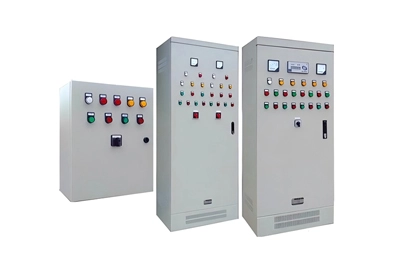
A pump control panel is an electrical control system used to start, stop, protect, monitor, and automate pump operation. In industrial applications, it may control one pump or multiple pumps based on pressure, flow, water level, temperature, process demand, or safety signals. A pump control cabinet houses the electrical and automation components inside a protective enclosure — the physical structure that contains the variable frequency drive, circuit protection devices, control logic, operator interface, sensors, and communication systems that together constitute the complete pump automation system.
The distinction between a traditional pump starter and a modern VFD pump control panel is the distinction between a system that answers "how do we turn the pump on and off safely?" and a system that answers "how do we run the pump only as fast as needed, while protecting the system, reducing energy cost, and providing the monitoring data that industrial energy management requires?"
A modern automatic pump controller integrated into a VFD pump control panel provides: motor starting and stopping with soft start or VFD ramp control, overload and short-circuit protection, phase loss and phase imbalance protection, constant pressure or constant flow control through VFD speed regulation, automatic and manual operating mode switching, multi-pump alternation for systems with duty and standby pumps, alarm and fault indication with fault history logging, remote monitoring and SCADA communication capability, and emergency shutdown with safe system state management.
Lubor's pump control panel is designed with automation, monitoring, energy-saving operation, fault protection, and customizable settings — providing the complete automation capability that industrial pumping systems require for reliable, energy-efficient operation.
The technical mechanism by which variable frequency drive control and soft start technology deliver the energy savings and equipment protection that justify pump control panel upgrade investment — and why these two technologies address different but complementary aspects of the pump system performance problem — is the core technical knowledge that plant engineers need to evaluate control system options.
Soft start technology gradually increases the voltage supplied to the motor during startup, rather than applying full voltage instantaneously as direct online starting does. This gradual voltage ramp reduces the inrush current from the six to eight times rated current of direct online starting to approximately two to three times rated current — a significant reduction in the electrical stress on motor windings and the mechanical shock on shaft couplings, impellers, and mechanical seals. Lubor states that soft starting typically reduces starting current to around two to three times the rated current and provides smoother, contactless, spark-free starting compared with direct online starting.
The mechanical benefit of soft starting is equally important. The gradual torque application of a soft start reduces the shock loading on the pump shaft, coupling, impeller, and mechanical seal at every startup — extending the service life of these components and reducing the frequency of seal replacements, coupling replacements, and bearing failures that direct online starting accelerates.
A variable frequency drive controls motor speed by adjusting the frequency and voltage supplied to the motor — allowing the pump to run at exactly the speed needed to deliver the required flow and pressure, rather than running at full speed and wasting energy through throttling. The energy-saving potential of VFD control in centrifugal pump systems is substantial because pump power consumption is strongly related to pump speed — reducing pump speed reduces power consumption significantly.
For systems where flow demand varies throughout the operating day — which describes the majority of industrial pumping applications — VFD control can deliver meaningful energy savings by matching pump speed to actual demand rather than running at full speed continuously. The actual saving depends on the specific demand profile of the system, but in variable-demand applications, energy savings of 15 to 30 percent are commonly achievable.
Water hammer prevention is one of the most commercially valuable but least frequently quantified benefits of VFD pump control panel upgrades. By starting and stopping the pump gradually — ramping speed up and down over a controlled time period rather than switching instantaneously — VFD control eliminates the sudden flow velocity changes that create water hammer pressure surges. Lubor notes that variable frequency control cabinets use a frequency converter as the starting device, with current rising gradually and pump speed adjusted according to working conditions to achieve stable flow and constant pressure control.
The financial value of water hammer prevention is the avoided cost of the pipe failures, valve damage, fitting leaks, and pump casing stress that water hammer creates over the operating life of the system. In systems with long pipelines, multiple valves, or a history of water hammer events, this avoided cost can be substantial — and it is a benefit that compounds over the full operating life of the upgraded control system.
The most commercially persuasive argument for a pump control panel upgrade is a clear, quantified ROI calculation that shows procurement decision-makers exactly how quickly the investment will pay back through energy savings and maintenance cost reduction. The following model provides a practical framework for this calculation.
Step 1: Calculate current annual energy cost
Annual Energy Cost = Pump Motor Power (kW) × Annual Operating Hours × Electricity Price ($/kWh)
Example: 75 kW motor × 6,000 hours/year × $0.12/kWh = $54,000/year
Step 2: Estimate annual energy saving after VFD upgrade
For a variable-demand system, a conservative energy saving estimate of 20 percent is reasonable.
Annual Energy Saving = $54,000 × 20% = $10,800/year
Step 3: Estimate annual maintenance saving
Reduced maintenance from softer starts, lower pressure shock, and extended component life:
Fewer mechanical seal replacements
Reduced bearing stress and replacement frequency
Less valve and pipe fitting damage from water hammer
Lower emergency repair cost from motor and coupling failures
Conservative maintenance saving estimate: $2,500/year
Step 4: Calculate total annual saving
Total Annual Saving = Energy Saving + Maintenance Saving = $10,800 + $2,500 = $13,300/year
Step 5: Calculate payback period
If the upgraded pump control cabinet investment is $26,000:
Payback Period = $26,000 ÷ $13,300 = approximately 1.95 years
| ROI Parameter | Example Value |
|---|---|
| Pump motor power | 75 kW |
| Annual operating hours | 6,000 hours |
| Electricity cost | $0.12/kWh |
| Current annual energy cost | $54,000 |
| Estimated VFD energy saving | 20% |
| Annual energy saving | $10,800 |
| Estimated maintenance saving | $2,500/year |
| Total annual saving | $13,300 |
| VFD control panel investment | $26,000 |
| Estimated payback period | ~1.95 years |
| Control Strategy | Energy Efficiency | Motor Protection | Water Hammer Risk | Best Application |
|---|---|---|---|---|
| Direct online start | Low — full speed always | Poor — high inrush current | High — sudden start/stop | Small pumps, infrequent starts |
| Star-delta start | Low — full speed always | Moderate | Moderate | Medium motors, limited budget |
| Soft start | Low — full speed always | Good — reduced inrush | Moderate — smoother start/stop | Fixed-speed applications needing motor protection |
| VFD pump control panel | High — speed matched to demand | Excellent — full soft start/stop | Low — gradual ramp control | Variable-demand systems, energy-saving priority |
| PLC + VFD cabinet | Highest — optimized multi-pump | Excellent | Lowest | Complex industrial systems, multi-pump optimization |
Selecting and procuring a VFD pump control panel for an industrial pumping application requires systematic evaluation of both technical requirements and supplier capability — and ongoing maintenance practices that protect control panel performance and energy-saving value over the system's service life.
Before requesting a quotation for customized VFD control panel solutions for industrial pumps, buyers should confirm the following:
Confirm pump motor power, voltage, phase, and rated current — these are the fundamental electrical parameters that determine VFD and circuit protection sizing
Confirm whether the application requires single-pump or multi-pump control — multi-pump systems require alternation logic, duty/standby control, and more complex PLC programming
Confirm the required control mode — constant pressure, constant flow, tank level control, or process-demand-based control — and verify that the supplier can program the required control logic
Confirm the sensor requirements — pressure sensors, flow meters, level sensors, and temperature sensors — and verify that the supplier can integrate the required sensors into the control system
Confirm the communication requirements — remote monitoring, SCADA integration, Modbus, Profibus, or Ethernet communication — and verify that the supplier can provide the required communication interface
Confirm the installation environment — indoor or outdoor, ambient temperature range, humidity, dust, and corrosive atmosphere — and verify that the cabinet enclosure rating is appropriate for the installation conditions
Confirm the cooling and ventilation requirements for the VFD — variable frequency drives generate heat during operation and require adequate cooling to maintain reliable performance
Confirm whether harmonic filtering is required — VFDs can generate harmonic disturbances in the power supply that may affect other equipment in the facility
Request wiring diagrams, component specifications, and parameter documentation before accepting delivery — this documentation is essential for commissioning, troubleshooting, and future maintenance
Confirm commissioning support availability — VFD pump control panels require professional commissioning to set control parameters, tune PID loops, and verify protection settings
Confirm spare parts availability and after-sales service — critical spare parts including VFD modules, contactors, and circuit breakers should be available from the supplier
Inspect cabinet ventilation and cooling fans at regular intervals — blocked ventilation is the most common cause of VFD overheating and failure
Keep the cabinet interior clean, dry, and dust-free — dust accumulation on VFD heat sinks and circuit boards reduces cooling efficiency and can cause insulation failure
Check wiring terminal tightness at regular maintenance intervals — loose terminals create resistance heating that can cause insulation damage and control failures
Verify sensor calibration regularly — pressure sensors and flow meters that drift out of calibration cause the control system to operate at incorrect setpoints, reducing energy-saving performance
Review VFD fault history at each maintenance visit — fault history provides early warning of developing problems including overheating, overcurrent, and communication errors
Monitor motor current, voltage, and frequency through the VFD display or monitoring system — deviations from normal operating values indicate developing pump or motor problems
Test emergency stop and alarm systems at regular intervals — safety systems that are not tested regularly may fail to operate when needed
Back up PLC and VFD parameters after commissioning and after any parameter changes — parameter backup allows rapid system restoration after a control component failure
Keep wiring diagrams and parameter records on site — maintenance teams need this documentation to troubleshoot faults and restore system operation after failures
Review energy savings data quarterly — comparing actual energy consumption against the pre-upgrade baseline confirms that the VFD is delivering the expected savings and identifies any performance degradation
For industrial plants seeking to reduce energy costs, improve equipment reliability, and demonstrate measurable progress toward energy efficiency and carbon reduction targets, a VFD pump control panel upgrade offers a combination of quantifiable savings, short payback period, and broad operational benefits that few other automation investments can match. The combination of variable frequency drive energy savings, soft start motor protection, water hammer prevention, and automatic pump controller logic creates a total value proposition that typically delivers payback in under two years — and continues delivering savings for the full operating life of the pumping system.
Lubor's pump control panel solutions are positioned for optimized pump performance, safety protection, reduced energy consumption, automation, monitoring, and customizable operation for industrial, agricultural, and water treatment applications — with the engineering capability to deliver customized VFD control panel solutions for industrial pumps across a wide range of power ratings, control modes, and installation environments.
Contact Lubor Pump today to discuss your pump power, voltage, flow demand, pressure target, operating hours, current starting method, water hammer history, and ROI target. Lubor can help evaluate the right VFD pump control panel configuration for your facility and provide the technical documentation, commissioning support, and after-sales service that a successful control system upgrade requires.
Q1: What is a pump control panel and how does it differ from a basic motor starter?
A pump control panel is an electrical control system that starts, stops, protects, monitors, and automates pump operation. A basic motor starter simply switches the motor on and off. A modern VFD pump control panel adds variable speed control, soft start capability, pressure and flow sensing, automatic control logic, fault protection, and remote monitoring — delivering energy savings, equipment protection, and process automation that a basic starter cannot provide.
Q2: How does a variable frequency drive save energy in a pump system?
A variable frequency drive adjusts motor speed by changing the frequency and voltage supplied to the motor, allowing the pump to run at exactly the speed needed to deliver the required flow and pressure. In variable-demand systems where flow requirements change throughout the operating day, VFD control avoids the energy waste of running the pump at full speed and throttling flow with valves — delivering energy savings that typically range from 15 to 30 percent in suitable applications.
Q3: How does soft start technology protect pump motors and reduce maintenance cost?
Soft start technology gradually increases motor voltage during startup, reducing inrush current from approximately six to eight times rated current with direct online starting to approximately two to three times rated current. This reduction in electrical and mechanical shock at every startup extends the service life of motor windings, shaft couplings, mechanical seals, and bearings — reducing the frequency of component replacements and the maintenance cost they create.
Q4: Can a VFD pump control panel prevent water hammer?
Yes. By starting and stopping the pump gradually through controlled speed ramps rather than switching instantaneously, VFD control eliminates the sudden flow velocity changes that create water hammer pressure surges. This protects pipes, valves, fittings, and pump casings from the pressure cycling damage that water hammer creates over the operating life of the system.
Q5: What information should buyers provide when requesting a quotation for a VFD pump control panel?
Buyers should provide pump motor power, voltage, phase, and rated current; required control mode (constant pressure, constant flow, or level control); number of pumps to be controlled; sensor requirements; communication and remote monitoring requirements; installation environment conditions; and whether VFD, soft start, PLC, HMI, or SCADA integration is required. This information allows the supplier to size the control system correctly and provide an accurate quotation.
<span style